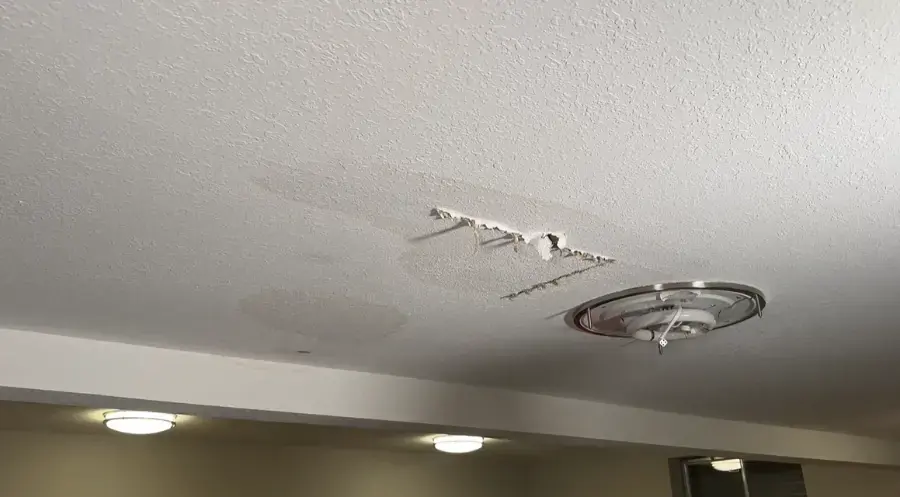
In Palmetto the air conditioner runs most of the year, and all that cooling produces water. That water is meant to leave through a small drain. When the drain clogs, it goes into the pan, over the edge and into the ceiling or the closet below.
Key takeaways
- Air conditioners in Palmetto run most of the year, so the condensate drain works almost all year.
- A brown or yellow ceiling stain near a hallway or closet is a common sign of a backed up AC drain.
- Shut off the AC at the thermostat and the breaker first, then look for the source before drying anything.
- Wet insulation, ceiling drywall and closet floors need to be opened and dried, not just painted over.
- A clogged drain tends to repeat. Fixing the drain and drying the structure are two separate jobs.
Where the water comes from
An air conditioner pulls moisture out of humid air as it cools. That moisture collects on the coil and drips into a pan, then runs out through a condensate drain.
Palmetto has a humid subtropical climate, and the rainy season runs June to September. Air that holds that much moisture means a lot of condensate, and that is why a drain that works fine in winter can fail in summer.
Slime, dust and debris build up inside the drain over time. Once it blocks, the pan fills and overflows.
Where the air handler sits changes where the water goes
Air handlers in Palmetto homes are often in a hall closet, a garage or the attic. Each location leads to a different kind of damage.
A closet unit tends to soak the floor and the bottom of the surrounding walls first. A garage unit can send water across the slab.
An attic unit drips through insulation and into the ceiling below, and the stain may appear far from the actual unit.
- Closet: wet floor, swollen baseboards, damp wall bottoms
- Garage: water spreading on the slab and into shared walls
- Attic: soaked insulation and a stained or sagging ceiling
Signs of an AC drain leak
Most homeowners notice the stain before they notice the cause. The air handler is often in a closet, a garage or the attic, so the leak starts out of sight.
Watch for these signs:
- A brown, yellow or gray ring on the ceiling below the air handler
- A wet or spongy floor inside a utility closet
- Water dripping from a ceiling vent or around a light fixture
- A musty smell in the hallway when the AC is running
- An air conditioner that stops cooling because a safety switch shut it off
What to do first
Turn the AC off at the thermostat, then at the breaker. A running unit keeps making water.
Do not climb into a hot attic to look for the source unless it is safe. Standing water, loose wiring and weak framing can all hide up there.
If the ceiling is bulging with water, keep people out from under it. A sagging section can drop without warning, and the crew can release it in a controlled way.
- Place buckets and towels where water is dripping
- Photograph the stain, the closet floor and the air handler
- Move furniture and contents out from under the wet area
- Leave the ceiling alone unless it is clearly about to fall
Safety around a wet ceiling
Water in a ceiling adds weight. A section that looks fine can hold a surprising amount of water, and drywall that has soaked for days can give way.
Light fixtures and recessed lights in a wet ceiling also carry wiring. If water is dripping from a fixture, the power to that circuit should be shut off at the breaker.
Do not poke holes in the ceiling unless water is clearly pooling and the room below is clear of people. A small controlled opening can relieve a bulge, but the crew is better placed to do it safely.
What drying involves
A small overflow that sat in a closet pan is a short job. A slow leak that soaked attic insulation and a ceiling is a longer one.
The AC leak water damage page covers the full process. The key steps are below, and the structural drying page explains how readings are taken.
Closet and floor
Water on the floor is extracted first. Baseboards are pulled so the bottom of the wall can dry, and flooring is checked for swelling.
Ceiling and insulation
Wet attic insulation holds water against the drywall, so it is removed. The ceiling is opened where it is saturated, and the joist bays above are dried.
The ceiling leak water damage page explains how stained ceilings are opened and dried.
- Moisture mapping shows the true edge of the wet area
- Air movers and dehumidifiers run in the room and the cavity
Questions to ask before work starts
A short conversation up front prevents surprises. These questions apply to nearly any ceiling or closet leak.
- Has the source been found and stopped?
- Is the wet area limited to one room, or does it follow the hallway?
- Was the insulation above the ceiling wet?
- Will the ceiling be opened, and how will it be rebuilt?
- How will moisture readings be shared?

Why a stain keeps coming back
Painting over a stain hides it but leaves the wet material behind. In a humid climate that material stays damp, and the stain reappears.
The drain itself also needs attention. If it clogged once, it will clog again. An air conditioning technician clears or replaces the drain, and some systems have a safety switch that shuts the unit off before the pan overflows.
Restoration covers the water. The drain repair is a separate trade, and both should happen.
What a slow leak does over time
A drain that overflows once is a mess. A drain that drips a little every day is a hidden problem.
Over a long run, the insulation above a ceiling stays wet and the drywall below softens. The humid climate then helps microbes grow on damp materials, and the room starts to smell.
A small amount of mold can show up on the ceiling or at the closet baseboard when this goes on for a while.
Catching the leak early keeps the work to a single section of ceiling. Catching it late can mean several rooms of ceiling, insulation and flooring.
Telling an AC leak from other ceiling leaks
Not every ceiling stain comes from the AC. A roof leak and a plumbing leak can leave the same mark.
An AC stain usually sits under or near the air handler, and it grows when the system runs. A roof leak grows during rain.
A supply pipe leak grows whenever water is used. If the source is unclear, the crew can use moisture readings to trace it before opening anything.
Prevention for a humid climate
Because Palmetto air conditioners work so many months, a little routine care pays off. A homeowner can check that the drain is clear and the pan is dry a few times a year.
If the pan is wet, or the drain pipe outlet has no flow while the AC runs, call a technician. Catching it early keeps the repair to a drain, not a ceiling.