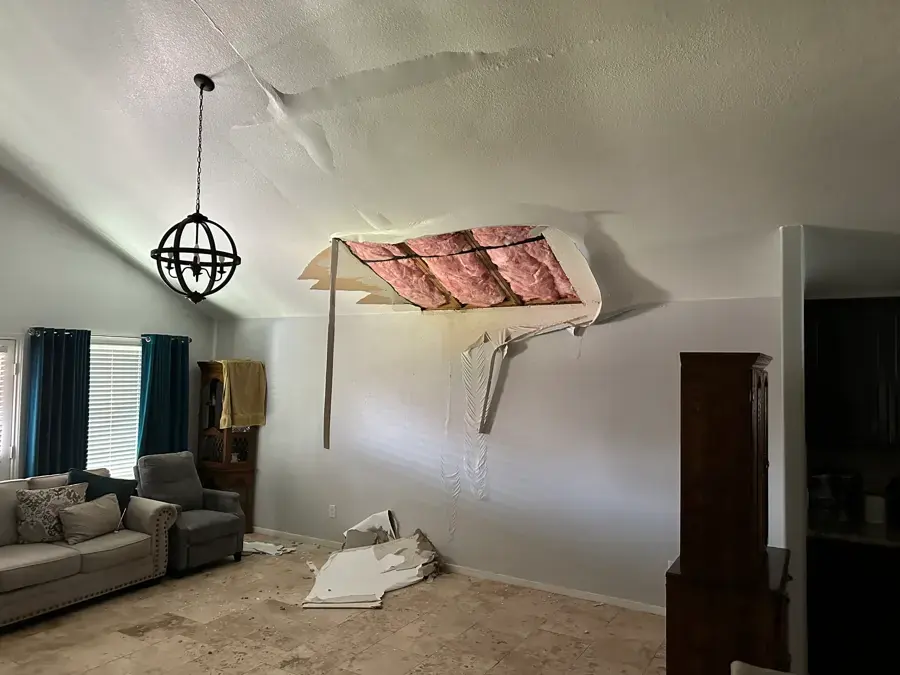
Longboat Key has many condominium buildings directly on the Gulf, along with waterfront single family homes. In a condo, a leak rarely starts in the unit that gets wet. It starts above, behind a wall or in a cabinet nobody has opened in a while.
Key takeaways
- A leak from the unit above can come from a washer, dishwasher, water heater, supply pipe or an overflowing tub.
- Photograph the damage, shut off what can be shut off and tell the unit owner above and the building management in writing.
- Water moves sideways through ceiling cavities and walls, so damage often appears far from the source.
- Dry both the ceiling and the wall cavities. A stain that looks small can sit on a large wet area.
- Keep records for the association and for the insurance claim, since more than one unit and policy may be involved.
How water travels from one condo to the next
The ceiling of one unit is the floor of another, and the space between holds framing, wiring and sometimes pipes. Water that escapes above does not fall straight down.
It follows the floor structure, runs along joists or concrete edges and drops where it finds a gap, such as a light fixture, a vent or a seam in the drywall.
That is why the stain may appear in a different room than the source.
- A washer hose or drain that fails
- A dishwasher or ice maker supply that leaks behind a cabinet
- A water heater tank in a closet
- A tub or shower that overflows or leaks at the drain
- A supply pipe inside a wall
First steps for the owner below
Water, wiring and a light fixture do not belong together. If water is coming through a ceiling fixture, shut off the circuit at the breaker.
The goal is to limit the damage and build a record. These steps work for most condo leaks.
Rule out the owner's own unit first. Check the water heater, the washer, the dishwasher and any tub or shower for a leak of your own, since a stain on a ceiling is not always from above.
If the water stops when the unit above shuts off its supply, the source is above. If it keeps coming, ask management to check the building's pipes.
- Photograph and video the stain, the dripping water and any damaged contents.
- Move furniture, electronics and rugs out from under the wet area.
- Set buckets and towels under drips, and leave sagging ceiling sections alone.
- Tell the unit owner above and the building management right away, and follow it with a short written note.
- Ask whether the water to the unit above can be shut off, so the leak stops.
Who needs to know
A condo leak involves several parties. The owner below, the owner above, the association and each insurance carrier may all have a role.
Building management can shut off a riser or valve if the source is not found. The association's rules usually say who handles repairs to common elements and who handles the inside of a unit, so it helps to ask early.
Written notes with dates keep the process clear. If the leak came from an appliance in the unit above, the owner above may be responsible for it, and an adjuster can sort that out after the water is dealt with.
A written notice is clearer than a phone call. It does not need to be long.
- The date and time the water was first noticed
- Where the water is entering and what it has damaged
- Photos attached
- A request to shut off the water to the source
- A request for a contact name and a reply date
What the restoration crew does
The first job is finding out how far the water went. A moisture meter and a thermal camera show the wet area behind paint, not just the visible stain.
The ceiling leak water damage page describes how stained and sagging drywall is opened and the cavity above is dried.
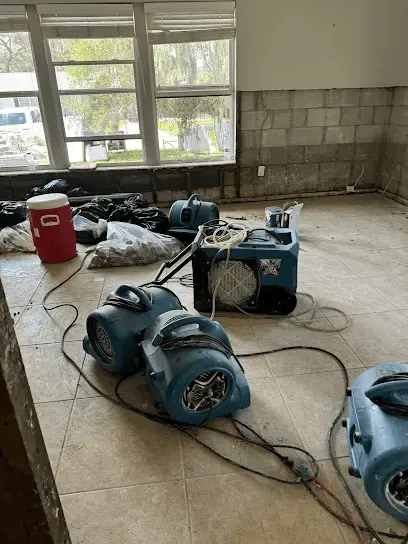
Drying equipment runs for several days and sits in the rooms the whole time. Keeping the unit closed, and leaving the equipment alone, keeps the drying on schedule.
If the unit above is also wet, drying both at once is usually faster and cheaper than doing one and then the other.
Ceiling and wall cavities
Wet insulation and soft drywall are removed. The cavity is opened enough for air to move through it, and equipment dries the framing and the back of the wall.
Floors and contents
Water that dripped down lands on flooring and furniture. Carpet and pad are extracted, hardwood or plank is checked for swelling, and cabinets are checked for wet bases.
- Extraction on carpet and hard floors
- Moisture checks on wall bottoms
- Contents moved or protected
Records for both units
Moisture readings from both units show how far the water traveled. Those readings help the association and the adjusters agree on the scope of the work.
The appliance angle
Many condo leaks begin with an appliance. The appliance leak water damage page covers washers, dishwashers, ice makers and refrigerators.
Supply hoses and drain hoses wear out. A leak behind a dishwasher or under a washer can run for days before anyone sees it, and in a unit that sits empty it can run longer.
That is a general pattern, not a local statistic.
A leak like that wets the floor under the appliance first, then moves through the floor and into the unit below.
Older buildings and why the date is not the whole story
Several condominium buildings on Gulf of Mexico Drive were built between 1970 and 1975, according to listing records. A building's age says little about any one leak.
Appliances, hoses and water heaters inside a unit are replaced on their own schedule. A new building with an old washer hose can leak just the same as an older one.
What matters is how quickly the water is found and how fully the wet area is dried.
Records that help later
Keep photos of every wet surface, the date the leak was noticed and notes on who was told and when. Save the association's written replies.
A list of damaged contents with rough ages and costs speeds up a claim. Keep any ruined items until the adjuster has looked at them.
The Longboat Key hub lists other water services for the island.
Owners above can lower the risk with a few habits. They are not complicated.
- Replace old washer and dishwasher hoses before they fail
- Know where the unit's water shutoff is
- Put a drain pan under the water heater
- Use leak sensors near appliances
- Shut off the water before leaving the unit for a long stretch